Google Local Services Ads vs. Google Ads: Which One Should Your Service Business Run First?
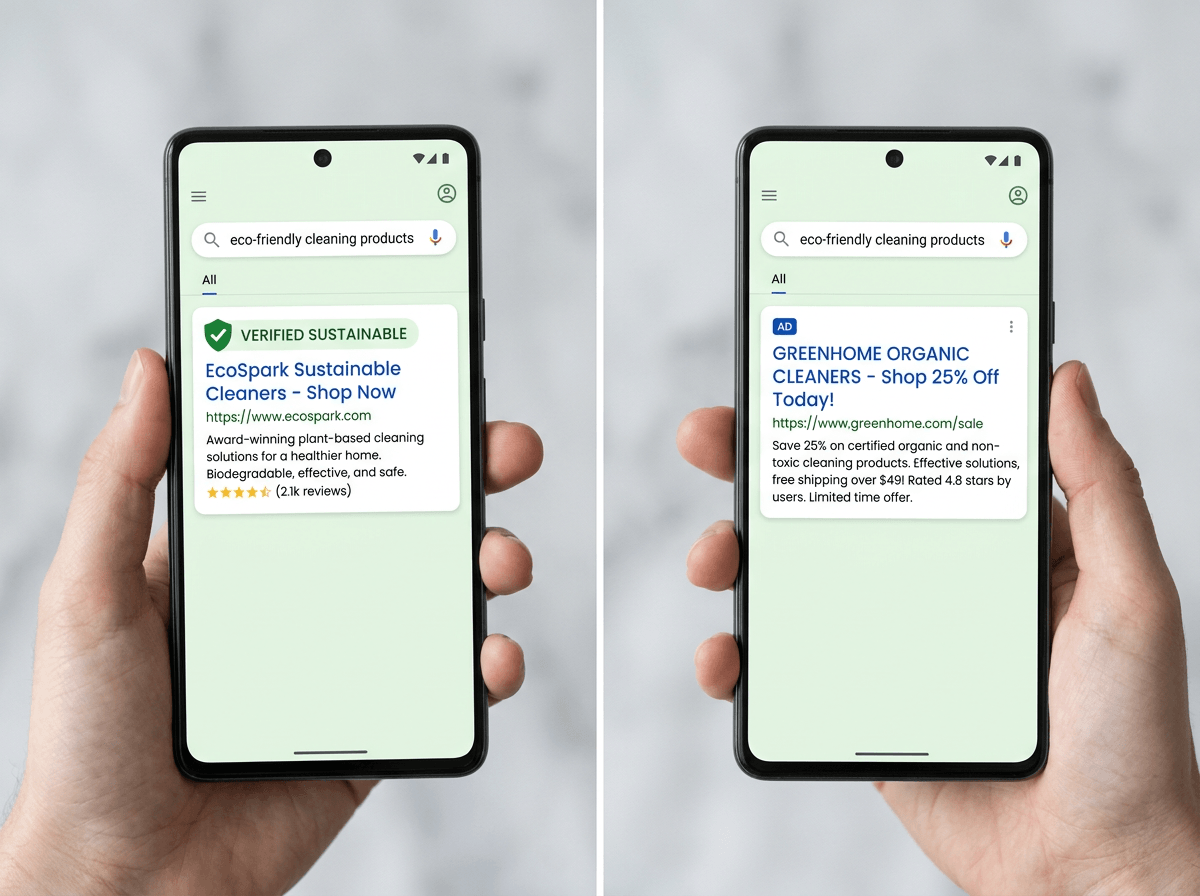
If you’ve spent any time on a Google results page for “plumber near me” or “AC repair [your city],” you’ve seen both ad units show up: a row of Local Services Ads at the very top with green checkmarks and star ratings, then standard Google Ads below them.
To a homeowner clicking around, those look like the same thing. They aren’t. They run on different auctions, charge for different actions, qualify different trades, and produce very different leads. Picking the wrong one for where your business is right now is one of the most expensive marketing mistakes a contractor can make.
Here’s the side-by-side most agencies won’t give you, and a framework for deciding which to run first.
The 30-second version
- Local Services Ads (LSAs) are at the top of the results page. You pay per lead, not per click. They require Google to background-check you, license-verify you, and insure-verify you. When you pass, you get the green “Google Guaranteed” badge.
- Google Ads are the text ads (and Performance Max placements) that show below LSAs. You pay per click, regardless of whether the click turns into anything. There’s no badge and no background check — just an auction.
LSAs are usually cheaper per lead. Google Ads gives you far more control. Neither one is automatically the right answer.
Cost per lead: the real numbers
This is where most contractors make their decision, so let’s get specific.
Local Services Ads cost per lead (2026):
- Cleaning / handyman: $15–$30
- Garage doors, locksmiths: $20–$40
- HVAC, electrical, plumbing: $30–$80
- Roofing, water damage, solar: $80–$200+
Google Ads cost per lead (2026):
- Cleaning / handyman: $25–$60
- Garage doors, locksmiths: $30–$75
- HVAC, electrical, plumbing: $70–$200
- Roofing, water damage, solar: $200–$600+
On average, LSAs come in 30–60% cheaper per lead than standard Google Ads in the same trade and market. That’s the headline most contractors hear, decide LSAs are obviously better, and stop reading.
Don’t stop reading.
Lead quality: where the picture flips
Cheaper leads aren’t automatically better leads. Here’s what each channel actually delivers:
Local Services Ads leads tend to be:
- High-intent (the homeowner clicked an “Call” or “Message” button right next to the price they saw)
- Mixed quality — you’ll get gold and you’ll get tire-kickers in the same week
- Shoppy — the homeowner often calls 3 LSA contractors in a row
- Tied to the trade Google approved you for (you can’t expand into related services as easily)
Google Ads leads tend to be:
- Higher commercial intent if you bid on the right keywords (e.g., “emergency AC repair” beats “how does AC work”)
- More controllable — you decide the keyword, the ad copy, the landing page, the offer
- Better suited for specialty or higher-ticket work (HVAC installs, full re-roofs, electrical panel upgrades)
- More expensive on a cost-per-lead basis but often more profitable on a cost-per-job basis
The summary: LSAs are great at filling your calendar with reactive service calls. Google Ads is better at hunting specific high-ticket jobs.
The Google Guaranteed badge is worth real money
This is the underrated piece of LSAs. The green checkmark next to your name signals to homeowners that Google has verified your license, insurance, and background. That trust alone moves the conversion-rate needle, especially in trades where homeowners are nervous about who they’re letting into the house.
Practical impact: most contractors see a 20–40% higher contact rate from LSA impressions than from organic listings or paid ads sitting in the same spot — purely because of the badge. If your trade is eligible, getting that badge is the cheapest brand asset you’ll ever earn.
You can’t get the badge with regular Google Ads. Full stop.
Which trades can even run LSAs?
LSAs aren’t available for every trade, and the list keeps shifting. As of 2026, Google supports LSAs for (among others):
- HVAC, plumbing, electrical
- Roofing, siding, windows
- Garage door, locksmith, appliance repair
- Pest control, lawn care, tree service
- Cleaning, junk removal, moving
- Water damage, fire damage, mold remediation
- Handyman, painting, flooring
- Pool services, foundation, concrete
If your trade isn’t on Google’s LSA list, the decision is made for you — run Google Ads.
Lead disputes: a quiet advantage for LSAs
This is the part nobody talks about. With LSAs, you can dispute bad leads — wrong number, spam, asked for a service you don’t offer, outside your service area — and Google will refund you for the ones it agrees with. A disciplined contractor disputing every week gets 10–20% of their lead spend back.
With Google Ads, every click costs what it costs. No refunds, no disputes. Your only protection is good negative keywords and tight targeting.
When to run LSAs first
LSAs are the right starting point if you can check most of these boxes:
- Your trade is eligible
- You can answer the phone fast (LSAs penalize slow response)
- You want to fill open capacity with service calls and small jobs
- Your budget is under $5,000/month and you need every dollar to work hard
- You’re a newer business without much SEO momentum yet
When to run Google Ads first
Google Ads is the right starting point if you can check most of these:
- You’re going after a specific high-ticket service (full HVAC install, full re-roof, kitchen rewire)
- You have a strong landing page and offer, not just a homepage
- You want control over which keywords trigger your ads
- Your trade isn’t LSA-eligible, or LSA volume in your market is too thin
- You already have an LSA running and need to scale beyond what it delivers
When to run both (most established contractors should)
Once you’re past the $5,000–$7,500/month total budget mark, the right answer is usually both. LSAs handle the high-intent, lower-funnel “call me right now” demand. Google Ads handles the specific job types you actually want — the higher-margin installs, the bigger tickets, the services with longer sales cycles.
A typical split for an established home service company:
- 50–60% of paid budget → LSAs (volume, capacity-filling)
- 40–50% of paid budget → Google Ads (specific high-margin jobs, brand defense, remarketing)
The decision framework, in one paragraph
If your trade is LSA-eligible and your budget is tight, start with LSAs. If you’re chasing a specific high-ticket service or your trade isn’t eligible, start with Google Ads. Once you’re past about $5K/month and your phone is ringing, run both — let LSAs catch the demand that’s already there, and let Google Ads hunt the jobs you actually want to win.
If you want help figuring out which one fits your shop today, we can walk through your numbers in a 20-minute call. We manage Local Services Ads and Google Ads for home service businesses across the country — and we’ll tell you straight up which one to start with, even if the honest answer is “neither one yet.”